
Why Are My Tomato Leaves Curling? How to Spot Herbicide Drift Damage
You walk outside one morning expecting to see healthy tomato plants, only to find the newest leaves curled, twisted, and growing in strange directions.
Your first thought is usually disease. Maybe insects. Maybe you watered too much...or not enough. You might even be tempted to grab a bottle of fertilizer or start spraying anything you can find in the garage.
Before you do, take a closer look.
Sometimes the problem isn't in your garden at all.
Last month, I was getting my vegetable garden ready for our annual community garden tour when I watched a neighboring field being sprayed. Within minutes, the smell of 2,4-D filled the air. I turned on the sprinklers to rinse off my tomatoes and peppers, then headed inside to wait.
By the next morning, the top leaves were curling and cupping.
One week later, the newest growth looked like melted candles. The older leaves were warping and twisting like crazy straws trying to spill out of a glass.
I've documented the damage from day one, and in this article I'll show you exactly what herbicide drift looked like in my garden, how to tell it apart from other common tomato problems, and what I'm doing while I wait to see if my plants recover.
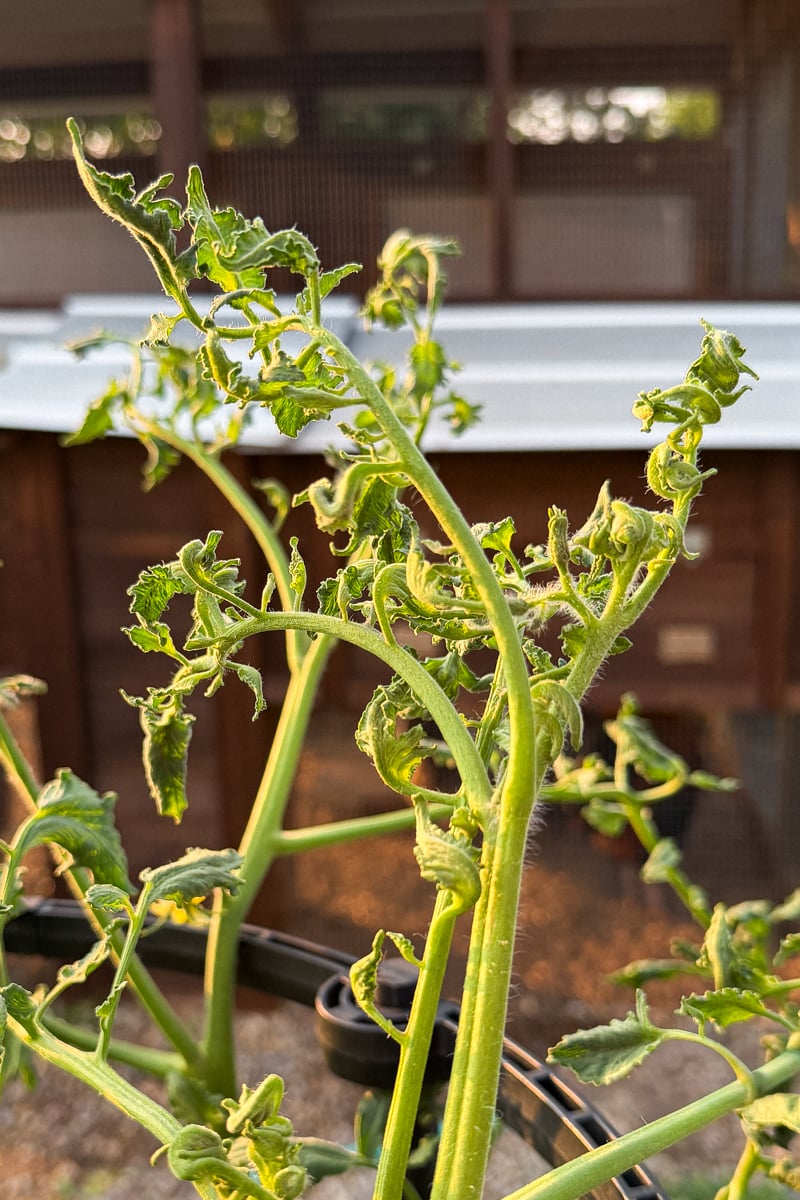
Symptoms of Herbicide Drift on Tomatoes
If your tomato plants suddenly changed overnight after nearby spraying, herbicide drift may be the cause.
Common signs include:
- Nearby peppers, potatoes, beans, grapes, or flowers showing similar damage
- New leaves curling or cupping upward
- Twisted stems and growing tips
- New growth that looks like melted candles
- Distorted or strap-like leaves
- Symptoms appearing first on the newest growth
What Herbicide Drift Looks Like on Tomatoes
Tomatoes are one of the most sensitive garden vegetables when it comes to auxin herbicides like 2,4-D and dicamba. It doesn't take much exposure for the newest growth to become distorted.
In my case, the symptoms didn't all appear at once. They developed over several days, which made documenting the progression incredibly helpful.
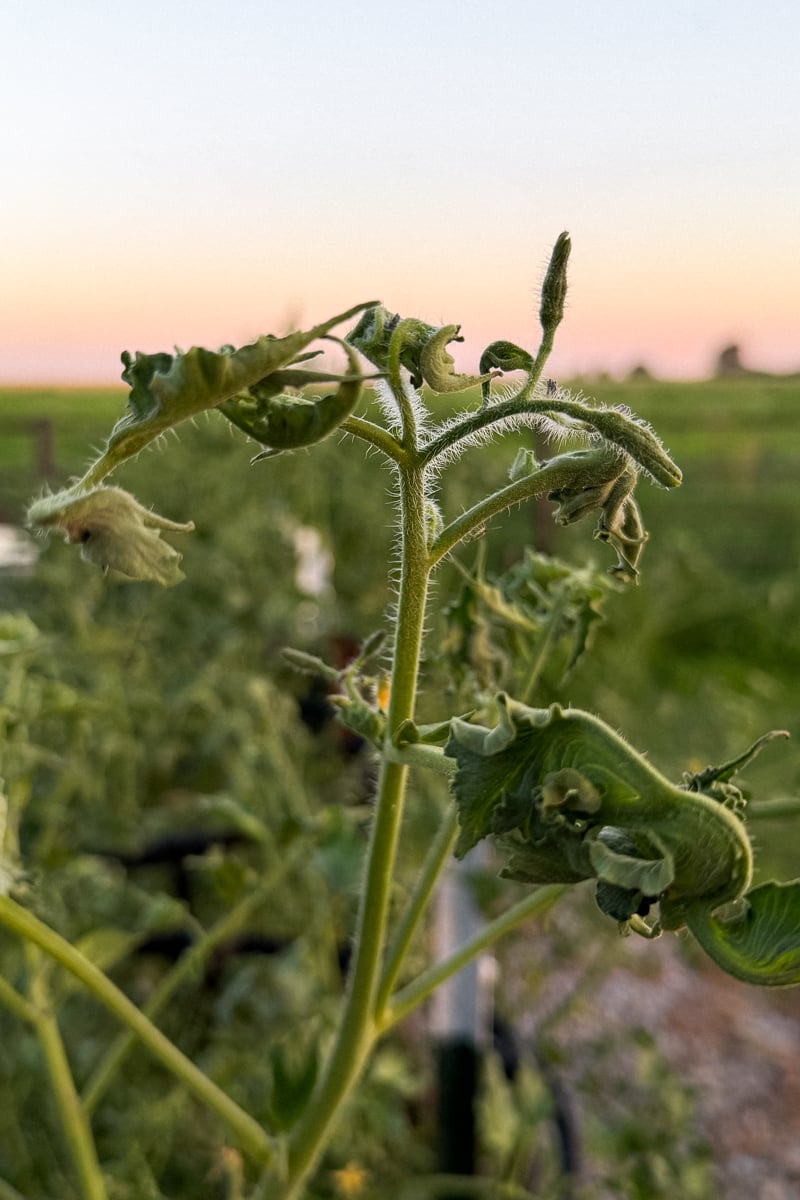
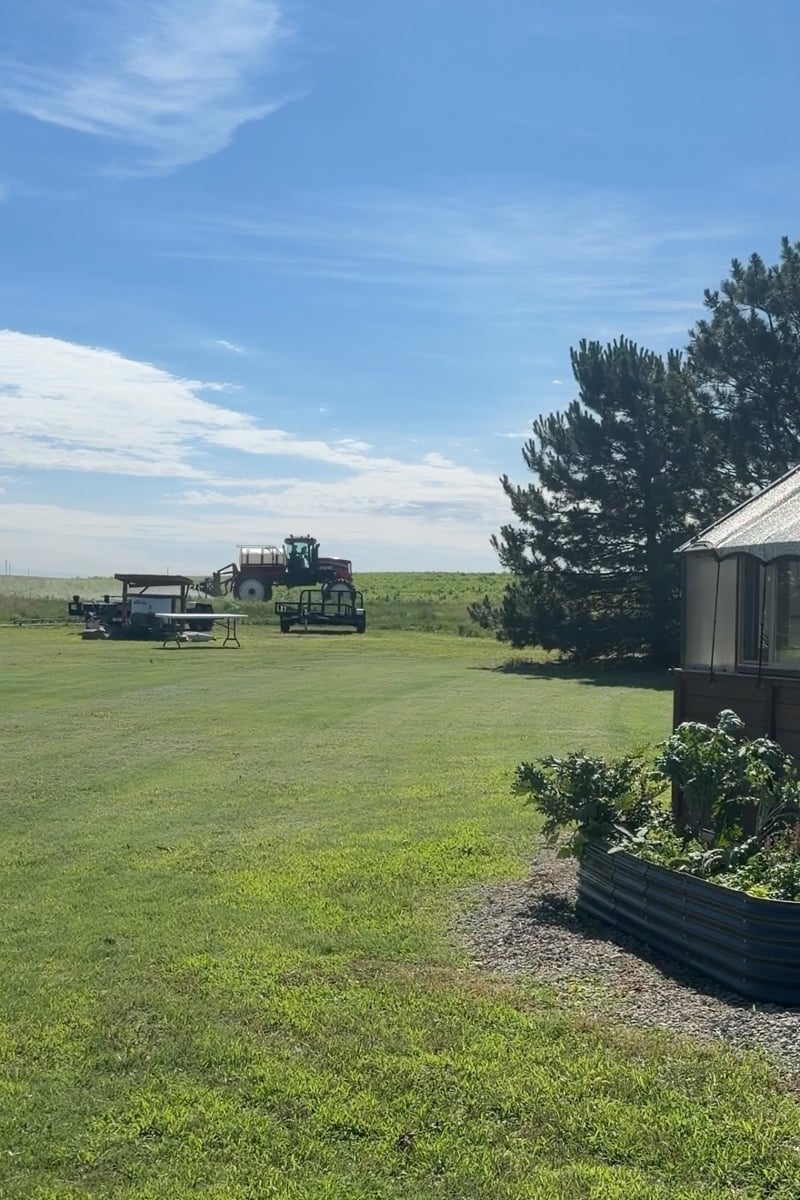
Day-by-Day: How Herbicide Drift Changed My Tomato Plants
June 12, 2026 - Day 0: The Spray Event
Last Friday I was getting my vegetable garden ready for our annual community garden tour when I noticed a spray rig enter the neighboring field. Unfortunately, the wind wasn't in our favor and it was blowing straight at my garden.
Within minutes, the smell of 2,4-D was unmistakable. Knowing tomatoes and peppers are especially sensitive to herbicide drift, I immediately turned on the sprinklers and thoroughly watered both crops before heading indoors.
At that point, there was no visible damage. All I could do was wait.
The next morning, I was hopeful my garden was going to be okay.
By day 3, the only symptom was the newest tomato leaves curling upward. It seemed minor enough that, if I hadn't watched the spray event the day before, I probably would have blamed the heat or assumed I'd missed a watering.
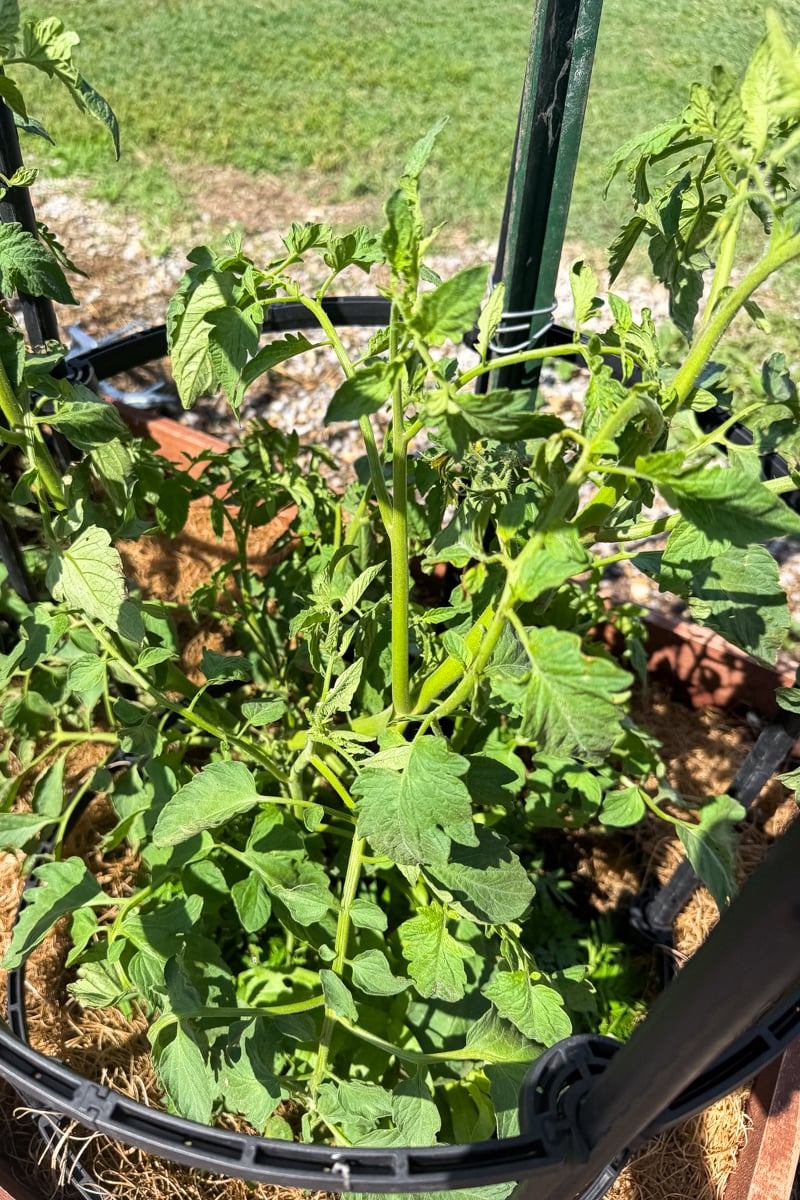
June 19, 2026 - Day 7: The Damage Became Obvious
About a week later, the symptoms had changed dramatically.
Instead of just the tomato leaves curling upward, the newest growth reminded me of melted candle wax as they curled around themselves.
By this point, I knew I wasn't looking at heat stress anymore. I was also seeing signs of damage in my cucumbers, peppers and even some of my annual flowers.
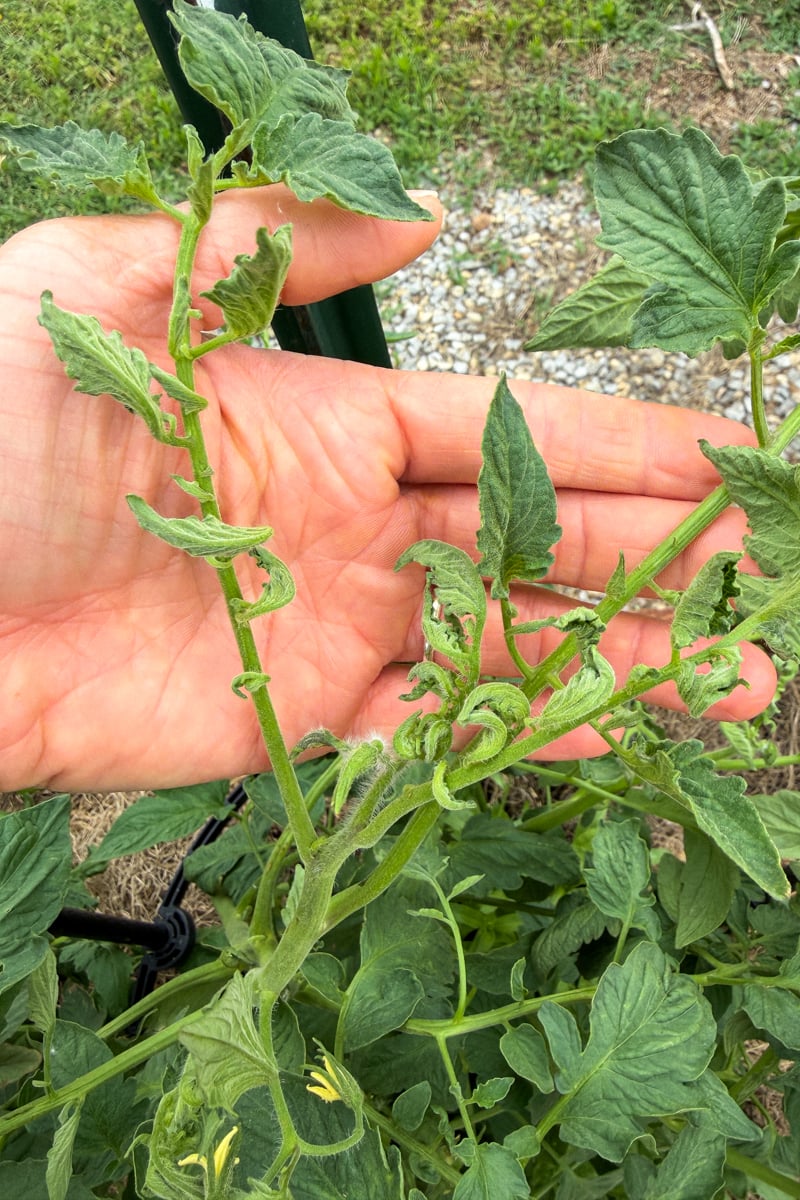
June 22, 2026 - Day 10: Time to Prune
Ten days after the exposure, I removed many of the lower leaves to improve airflow around the plants.
I still wasn't seeing signs of recovery, but I also wasn't ready to pull my tomatoes and start over. Besides, it's almost July. There wouldn't be enough time to actually harvest any tomatoes if I tried again with new plants.
Although the older leaves still looked fairly normal, every new growing tip continued emerging distorted, making it clear the injury hadn't stopped progressing.
At this point my plan was simple:
- Keep watering consistently.
- Avoid unnecessary stress.
- Wait.
June 26, 2026 - Day 14: A Surprising Development
By the second week, I expected the damage to level off.
Instead, it became more severe.
The newest growth continued twisting, and some of the plants appeared even weaker than they had just a few days earlier. Every morning I'd walk outside hoping things looked a little better, but it kept getting worse. Instead of looking for signs of recovery, I found myself looking for new symptoms.
Then something unexpected happened.
Several plants began setting their first tomatoes.
Whether that fruit set was simply normal timing or a response to the stress, I can't say for certain. Tomatoes sometimes continue flowering and producing fruit under stressful conditions, and it'll be interesting to see how these plants perform over the rest of the season.
I have a theory, although I can't prove it. I wonder if the stress triggered the plants to shift energy toward reproduction instead of leafy growth. Almost like a botanical Hail Mary, trying to produce seed before it was too late.
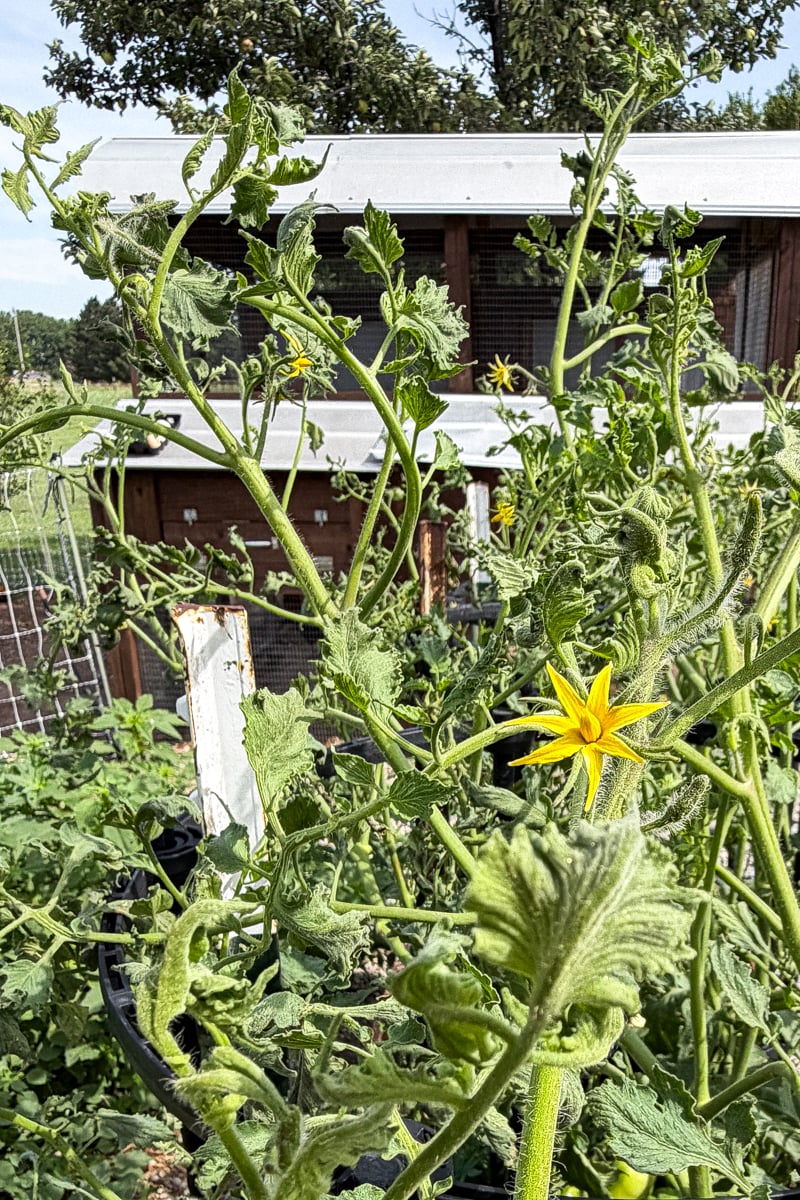
July 3, 2026 - Day 21: From Bad to Worse
This wasn't the update I expected to be writing. I expected the plants to deteriorate and curl, and then as time went on recover with healthy new growth. That's not what I'm seeing, though.
You might be thinking, "Well, Meg, it's July in Kansas. Tomatoes do tend to fry and look bad this time of year." While that is true, we've had an unseasonably cool summer. The temperatures have been beautiful and mild, we've had consistent rain (hallelujah!), and these tomatoes should be the best we've ever had.
I've learned a lot about herbicide drift over the past three weeks. One word I didn't know before all of this was epinasty. It's the scientific term for the twisting and downward curling caused by abnormal plant growth.
Herbicides like 2,4-D work by mimicking auxin, a natural plant hormone that controls growth. Once the plant absorbs too much of that hormone signal, it essentially gets confused. Cells on one side of the stem grow faster than the other, causing the leaves to curl, stems to bend, and new growth to become tightly twisted. I think this is why the damaged plants aren't able to snap out of it as time goes on.
What I'm continuing to see this week:
- Twisted, cupped new leaves.
- Bent petioles and stems.
- Distorted growing tips.
- Leaves that are much smaller and puckered than normal.
- Fruit continuing to set despite the damage.
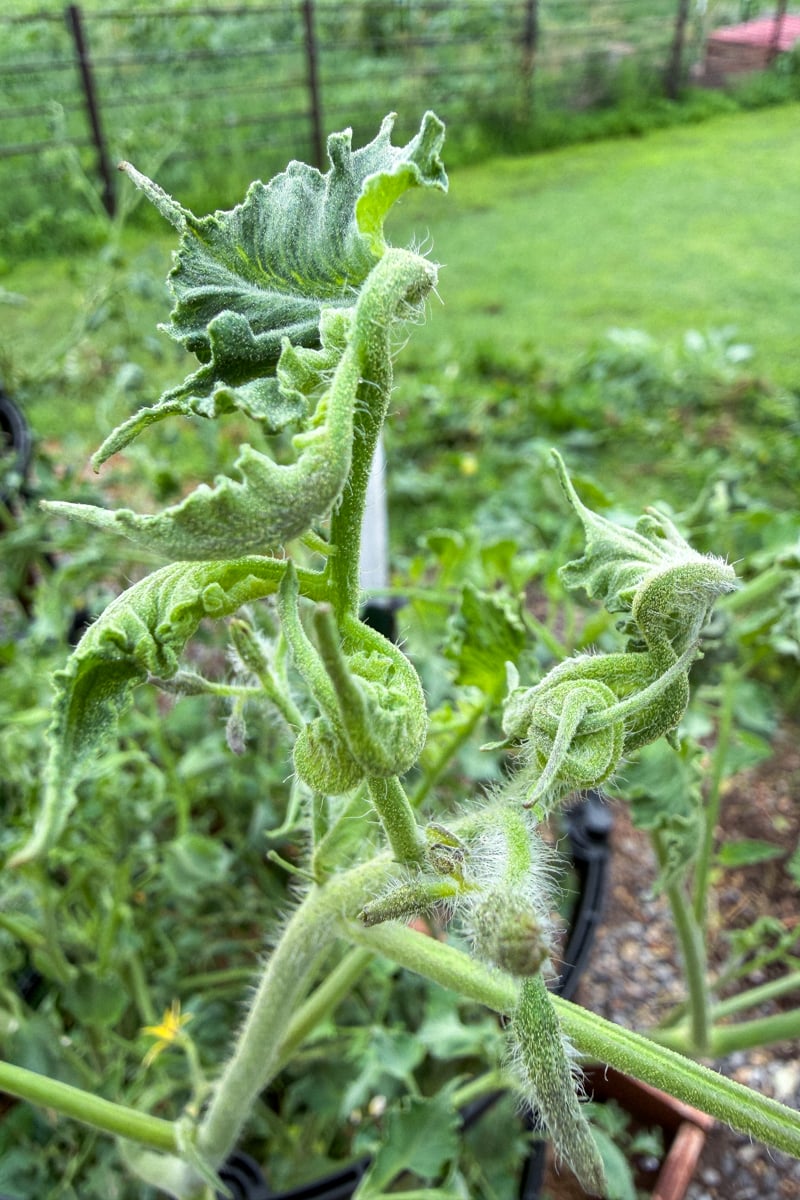
July 14, 2026 – One Month Later... and Another Spray Day
Just when I thought this journal couldn't get any more interesting, the neighboring field was sprayed again.
This time, the conditions were much different. The wind was light instead of blowing directly toward my garden at 15 mph, and while I could smell the herbicide during the application, the odor dissipated fairly quickly afterward. I'm hopeful my replacement tomatoes escaped with little or no damage, but only time will tell. As I've learned over the past month, herbicide injury often takes several days before the full extent becomes visible.
Over the last month, I've also made a decision about the original drifted plants.
I've decided my family will not be eating tomatoes from the plants that were exposed during the first drift event.
That doesn't mean I'm pulling them out.
At this point, the season is too far along to start over, and I'm simply too curious to stop watching. The gardener in me wants to know what happens next. Will they eventually produce healthier new growth? Will they continue setting fruit until frost? Will the damage ever level off?
So the experiment continues.
I'll keep watering them, caring for them, and documenting what I see until the season comes to an end. If nothing else, I hope this journal becomes a helpful resource for the next gardener who finds themselves standing in their backyard wondering why their tomato plants suddenly started twisting overnight.
They're battered, twisted, and nothing like they should look this time of year. But every morning I find another yellow blossom opening or another tiny green tomato beginning to grow.
I still don't know how this story ends. I'll keep updating this journal as the season goes on.
Gardener's Journal
One of the reasons I'm documenting this timeline is because I couldn't find many real-world examples showing how herbicide drift changed tomato plants over time.
I'll continue updating this article throughout the growing season so you can follow along with the recovery—or lack of it.
Could It Be Something Else?
| Problem | What It Looks Like | How It's Different from Herbicide Drift |
|---|---|---|
| Herbicide Drift | New leaves curl, cup, twist, or look like melted candles. Growth becomes distorted, often within days of nearby spraying. | Damage starts on the newest growth and often affects several sensitive plants in the garden at the same time. |
| Heat Stress / Physiological Leaf Roll | Older leaves roll upward like little tacos during hot weather. Leaves stay green and otherwise healthy. | Plants continue growing normally and new growth isn't twisted or distorted. |
| Overwatering or Underwatering | Leaves may wilt, curl, or droop. Soil is either consistently soggy or very dry. | Usually affects the entire plant rather than just the newest leaves, and improves once watering is corrected. |
| Broad Mites | Tiny, nearly invisible mites cause twisted, thickened, or bronzed new growth. Flowers may abort. | Usually begins on one plant and requires close inspection or magnification to identify the mites. |
| Tomato Viruses | Mottled leaves, yellowing, stunted growth, and unusual leaf shape. | Symptoms often include discoloration or mosaic patterns in addition to leaf distortion. |
| Nutrient Deficiency | Yellowing leaves, poor growth, or purpling depending on the nutrient involved. | Nutrient problems rarely create the dramatic twisting and "candling" seen with herbicide injury. |
The biggest clue in my garden wasn't just the curled tomato leaves.
It was that multiple sensitive plants began showing symptoms at the same time.
In addition to tomatoes, I noticed damage on:
- peppers
- squash
- cucumbers
- strawberries
- several annual and perennial flowers
When several unrelated plants suddenly develop distorted new growth after nearby spraying, herbicide drift moves much higher on the list of possible causes.
What Causes Herbicide Drift?
Herbicide drift happens when a weed killer moves away from the area where it was intended to be applied and reaches nearby plants.
While many people immediately think of large farm fields, herbicide drift can happen anywhere herbicides are used. A neighboring farmer spraying a crop field, a homeowner treating weeds along a fence line, or someone spraying a driveway or ditch can all unintentionally affect sensitive garden plants if the conditions are right.
Tomatoes are among the most sensitive garden vegetables to auxin herbicides like 2,4-D and dicamba. Even very small amounts can cause distorted new growth, curled leaves, and the twisted "melted candle" appearance many gardeners notice after exposure.
One thing I found interesting while researching herbicide drift is that not all drift happens the same way. It also shows up differently based on the herbicide used and the environmental factors that particular day.
Physical Drift
Physical drift happens when tiny spray droplets are carried away by the wind during application. This is the type most people picture when they think of herbicide drift.
Wind speed, droplet size, application equipment, temperature, humidity, and nearby obstacles can all influence where those droplets end up.
Vapor Drift
Some herbicides can also move after they've already been sprayed.
Under the right weather conditions, certain products can form vapors that move away from the treated area. This is often called vapor drift or volatility, and it can affect sensitive plants even after the sprayer has left.
This happened to my garden a few years ago when a cotton field more than half a mile away was sprayed with Dicamba. I lost all of my tomato plants that year.
The Takeaway
The goal of this article isn't to point fingers or assign blame. Truly. I want to help other gardeners learn from my experience.
Herbicides are a common tool used by farmers, landscapers, municipalities, and homeowners alike. Most applications happen without any issues at all.
But if your tomatoes suddenly develop curled, twisted, or distorted new growth, knowing how to recognize the symptoms of herbicide drift can help you make informed decisions about what to do next instead of wondering what went wrong.
The sooner you can identify the likely cause, the sooner you can focus on documenting the damage, reducing additional stress on the plants, and deciding whether it's best to wait for recovery or start over.
What Should You Do If You Suspect Herbicide Drift?
If you suspect herbicide drift, the first instinct is usually to do something.
Mine was too.
But after researching the issue, I decided the best course of action was actually to do less, not more.
Here's what I recommend:
1. Don't panic.
Leaf curl doesn't automatically mean your tomatoes are lost.
Some plants recover surprisingly well.
2. Take photos immediately.
You'll be amazed how quickly symptoms change.
My own photos just a few days apart looked completely different.
3. Avoid adding more stress.
I chose not to fertilize.
I also avoided unnecessary pruning until later.
Instead, I focused on consistent watering.
4. Look beyond the tomatoes.
Are peppers, beans, grapes, cucumbers or flowers showing similar symptoms?
Multiple affected species are a strong clue.
5. Be patient.
Symptoms often continue developing for several days or even weeks.
Don't assume the damage is finished just because the plants haven't gotten worse today. The next morning, when the tomatoes only had a little leaf cupping, I remember thinking, "Oh! I think we're going to be okay." Then I learned herbicide injury often gets worse before it gets better.
Should You Report Herbicide Drift?
Every situation is different, and there isn't one "right" answer.
In my case, the neighboring field was being sprayed by a farmer we've had a good relationship with for years. I don't believe this was intentional or malicious. Based on the wind direction that day, I think it was simply an unfortunate combination of weather and timing.
If I had chosen to pursue the matter (which I did not), my first phone call would have been to him. He may not have even realized herbicide had reached my garden, and I think it's always worth having a conversation before assuming the worst.
For me, that's where it ended. I chose to document the damage, continue caring for my plants, and see how they recovered.
If your situation is different, you also have the option of reporting suspected herbicide drift to your state's department of agriculture. In Kansas, that would be the Kansas Department of Agriculture, which investigates pesticide misuse complaints and can explain the next steps in the process.
If you're considering filing a report, it's helpful to:
- Take clear photos of the damage as soon as you notice it.
- Continue documenting changes over the following days and weeks.
- Make note of the date and approximate time you believe the exposure occurred.
- Write down any details you observed, such as nearby spraying, wind direction, weather conditions, or unusual odors.
- Avoid removing damaged plants until you've decided how you want to proceed, since they may be useful for documentation.
Whether you decide to simply monitor your plants, have a conversation with the applicator, or file a report is a personal decision. My hope is simply that this article helps you recognize the symptoms early enough to make an informed choice.
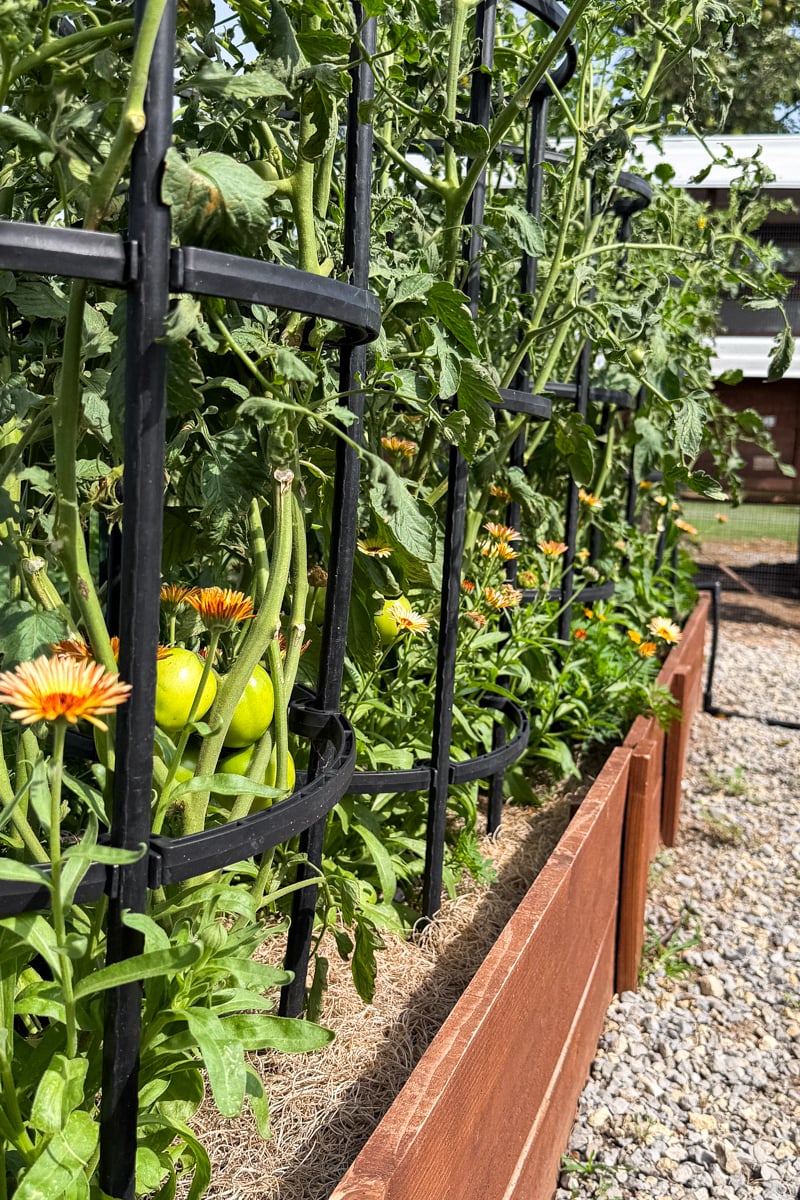
Will My Tomatoes Recover?
That's the question I wanted answered when this first happened.
The honest answer is: I don't know yet.
Some gardeners report that lightly affected tomato plants eventually grow out of the damage and produce a decent harvest. Others say their plants never fully recovered, especially after more severe exposure. The outcome depends on many factors, including the herbicide involved, how much drift reached the plants, the stage of growth, and the overall health of the tomatoes before the exposure.
Since my garden was exposed in mid-June, I decided not to pull the plants immediately. Instead, I'm documenting what happens week by week so you can see exactly how the damage progresses and whether these tomatoes eventually recover.
At the time I'm writing this, the plants are still flowering and setting fruit despite the severe twisting and distorted new growth. Whether they'll return to normal later this season is something I simply don't know yet.
I'll continue updating this article as the season progresses so you'll be able to see the final outcome, not just the first symptoms.
Frequently Asked Questions
Sometimes. Recovery depends on how much herbicide reached the plant, the type of herbicide, the weather, and the overall health of the tomato plant. Mild cases may eventually grow out of the damage, while severe cases can remain stunted or stop producing altogether.
I'm continuing to document my own plants throughout the growing season and will keep this article updated as they either recover or decline.
My personal approach was not to fertilize immediately after the drift event. I wanted to avoid putting additional stress on the plants while they were already responding to the exposure. Instead, I continued watering consistently and watched the new growth carefully before making any other changes.
Many gardeners ask this question after seeing distorted leaves. Whether fruit is safe to eat depends on several factors, including the herbicide involved and how the exposure occurred. If you're unsure what product was applied or have concerns about food safety, contact your local Extension office or state Department of Agriculture for guidance specific to your situation.
Symptoms often continue developing for days or even weeks after the initial exposure. New growth usually shows the most severe damage. Some plants gradually recover over time, while others continue declining. This is one reason I recommend taking photos every few days so you can track changes instead of relying on memory.
Tomatoes are among the most sensitive vegetables, but they aren't alone. Peppers, potatoes, beans, peas, grapes, strawberries, and many flowers can also show injury from auxin herbicides like 2,4-D and dicamba. In my own garden, I noticed symptoms on tomatoes, peppers, cucumbers, squash, strawberries, and several flowers.
Heat stress usually causes older leaves to roll upward while the plant continues producing normal new growth. Herbicide drift typically affects the newest growth first, causing twisted stems, curled leaves, and the "melted candle" appearance shown throughout this article.
This article is still being written.
I'll continue adding photos and updates throughout the season so you can see exactly what happened—from the first curled leaves all the way through harvest.
Final Thoughts
Gardening has a funny way of keeping us humble.
One week you're admiring healthy tomato plants, and the next you're standing in the garden wondering what in the world happened and why your tomato leaves are curling.
While I wish this herbicide drift story had never happened, I'm thankful it gave me the opportunity to document the symptoms from the very beginning. When I started researching my own plants, I realized there weren't many real-life examples showing what herbicide drift actually looks like day by day.
That's exactly why I decided to share my experience.
If your tomato leaves are suddenly curling, twisting, or growing in strange directions, don't panic. Slow down, take good photos, look at the newest growth, and consider everything that happened in the days leading up to the damage.
Sometimes the answer is herbicide drift.
Sometimes it's something else entirely.
Either way, careful observation is one of the best gardening tools you have.
I'll continue updating this article throughout the growing season as my tomatoes either recover or decline, so check back for new photos and updates. Hopefully, by the end of the season, we'll both know how this story ends.
If you've experienced herbicide drift in your own garden, I'd love to hear what happened. Your experience may help another gardener recognize the signs sooner.
More Gardening Posts
- How I grow tomatoes in my Kansas garden
- Growing peppers in Zone 6
- Coffee grounds for tomato plants
- Growing cucumbers on a trellis
- Organic pest control in the garden
- My Yoderbilt greenhouse





Comments
No Comments