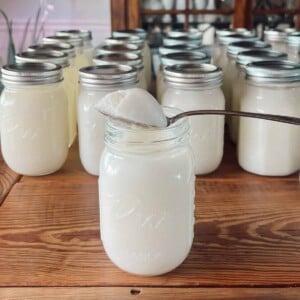
How to Render Lard
Lard is a smooth, neutral, and creamy animal fat perfect for baking, grilling, frying, and much more. This melted fat is solid at room temperature and liquid when warm. It's also shelf stable! Keep reading to learn how to render lard.
Equipment
- large dutch oven, stainless steel pot or slow cooker
- wooden spoon
- mesh strainer
- cheese cloth
Ingredients
- 10 pounds Pork fat trimmed
Instructions
- Trim any excess meat or skin from the raw fat. Cut the fat into chunks.
- Place the fat pieces in a freezer-safe container or bag and freeze overnight. Freezing firms up the fat, making it easier to grind and helping it render more evenly and efficiently.
- Grind the frozen fat using a meat grinder or food processor. Grinding the fat helps increase surface area, speeding up the rendering process. You can also chop it with a knife into small pieces.
- Transfer a small amount of the frozen fat to a large, heavy-bottomed pot or Dutch oven. Place it over low heat to medium heat. As the chunks of fat melt, begin adding more fat to the rendered fat. We have found that adding too much fat to the dutch oven actually hinders more than helps.
- Allow the fat to slowly melt, stirring occasionally to prevent sticking or burning. Be patient, as this process can take several hours.
- Keep an eye on the temperature of the fat. Ideally, you want to maintain a temperature between 225°F to 250°F (107°C to 121°C) to gently melt liquid fat without burning it.
- As the fat renders, you may notice foam or impurities rising to the surface. Use a spoon or ladle to skim off these impurities and discard them.
- Once the fat has completely melted to a liquid state and there are no more impurities rising to the surface, it's time to strain the lard. Line a fine mesh sieve or cheesecloth over a heatproof container and carefully pour the liquid lard through it to remove any remaining solids. There will be many small pieces that do not fully render.
- Allow the strained lard to cool to room temperature before transferring it to a clean, dry jar or container. Store the lard in the refrigerator or freezer for long-term storage.
Notes
HOW TO RENDER LARD IN A SLOW COOKER
- Follow steps 1,2 & 3 above. Transfer the fat pieces into the slow cooker, filling it about three-quarters full. You want to leave some space for the fat to melt and for stirring.
- Add a Small Amount of Water: To prevent the fat from sticking to the bottom of the slow cooker and to help regulate the temperature, add a small amount of water to the bottom of the cooker. Just enough to create a thin layer, about ¼ to ½ inch deep.
- Set Slow Cooker to Low: Turn the slow cooker to its lowest setting. This will ensure a gentle heat that slowly melts the fat without burning it.
- Cook for Several Hours: Allow the fat to melt and render in the slow cooker for several hours, typically 6 to 8 hours or overnight. Stir the fat occasionally to ensure even melting and to prevent sticking.
- Continue with steps 7, 8 & 9.
Nutrition
Calories: 40.914kcalFat: 4.536gSaturated Fat: 1.778gPolyunsaturated Fat: 508gMonounsaturated Fat: 2.046gCholesterol: 4.309mg
Tried this recipe?Share it with us @NinnescahHomestead